


MOGADISHU – This press release marks three years and three months since the election of President Hassan Sheikh Mohamud. It offers a comprehensive assessment of Somalia’s current condition, the progress and stagnation in the state-building process, and the overall state of governance in the country.
President Hassan Sheikh was elected and sworn into office under a nationally agreed-upon Provisional Constitution, rooted in a federal system, a parliamentary framework, and a consensus-based electoral process held every four years. However, it is deeply unfortunate that today, Somalia finds itself in a constitutional vacuum. The president has attempted to unilaterally amend core chapters of the 2012 Provisional Constitution—actions that blatantly disregard the legal process for constitutional reform.
What once served as the binding legal framework uniting the Somali people and their state is now fractured. Governance today is driven not by a legitimate constitutional order, but by the personal ambitions of President Hassan Sheikh.
Thirty-five years ago, Somalia’s statehood collapsed under a ruler who clung to power and dismantled the constitutional consensus. Today, with only eight months and 25 days left in President Hassan Sheikh’s term, the country still lacks an agreement on the upcoming federal elections—an absence that threatens to plunge the nation into renewed political conflict and uncertainty.
In the capital, Mogadishu, a non-consensual electoral process is already underway—lacking both political legitimacy and public trust, and enforced through coercion, armed force, and intimidation.
The unity of the nation is at serious risk. The federal government has severed ties with the Puntland and Jubbaland administrations, with whom it now has openly hostile relations. These divisions have escalated into broader political fragmentation, undermining the country’s unity and placing Somalia’s statehood on shaky ground.
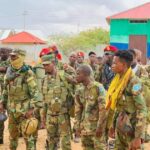
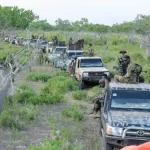
In several regions, conflicts and tensions are being stoked by the policies of the current administration. Tragically, Somali soldiers—trained and equipped to protect the nation and fight extremist groups—are now entrenched in battle lines against each other in Gedo region.
Somalia’s economic situation is deteriorating rapidly. Markets are deserted, and Somali entrepreneurs are fleeing the country, moving their investments abroad to escape the crippling conditions created by President Hassan Sheikh’s government. As domestic economic confidence collapses, so does hope for recovery.
President Hassan Sheikh was entrusted with a country where every district and neighborhood in the capital included public lands reserved for communal benefit. It is a national tragedy that today, the President himself is reportedly purchasing public lands through illicit channels and forcibly evicting poor families who had long lived there. Even private lands owned by ordinary citizens are being illegally seized under the guise of state authority.
Somalia’s government is heavily reliant on international aid—67% of its budget is funded by global donors. Yet we live in a changing world, where decisions are no longer made as they once were. Significant geopolitical shifts are unfolding both globally and across the Horn of Africa, demanding a far more responsible and capable response from Somalia’s leadership.
Due to corruption and mismanagement under President Hassan Sheikh’s administration, international confidence in Somalia has plummeted. Donors are reviewing their financial commitments. The funds previously earmarked for the African Union peacekeeping mission in Somalia remain in limbo, with growing doubts about their release.
Development projects planned by international agencies have failed to take off due to the government’s lack of capacity and transparency. As a result, nearly half a billion dollars in development funding has been returned to international donors—lost opportunities for Somalia’s recovery.
We are deeply pained by what is unfolding in our homeland:
• We cannot accept that every day, poor Somali mothers are being forcibly evicted by a government they once trusted to protect them.
• We cannot accept that public lands—meant for schools, hospitals, and future generations—are being auctioned off in black markets, while the records of public assets are erased.
• We cannot accept that extremist groups are gaining ground in territories where national heroes once shed blood for Somalia, while the government is busy seizing land from destitute citizens, many of whom are the families of national soldiers.
• We cannot accept that the very soldiers trained to fight terrorism are now deployed to displace the urban poor, manning checkpoints in neighborhoods and marketplaces.
• We cannot accept that national forces are fighting and killing one another in peaceful regions, in service of private political interests.
• We cannot accept that Somali businesspeople are fleeing with their capital, families are abandoning the country, and our youth—driven by despair—are risking death at sea.
• We cannot accept that government forces are kidnapping civilians from streets and homes to force them into a sham voter registration process.
• We cannot accept that national unity is being systematically dismantled, replaced with dangerous factionalism and political fragmentation.
• We cannot accept a government whose conduct is increasingly driven by unchecked power, cronyism, and widespread corruption.
Mr. President, what we could not accept from your predecessor, we will not accept from you. What we failed to achieve together cannot be imposed by force.
For the sake of the country, for the people of Somalia, step aside and allow the nation to be rescued from this crisis.
Written by: Hassan Ali Khaire
Former Prime Minister of Somalia