

“Who protects the truth-tellers when truth itself becomes dangerous?”
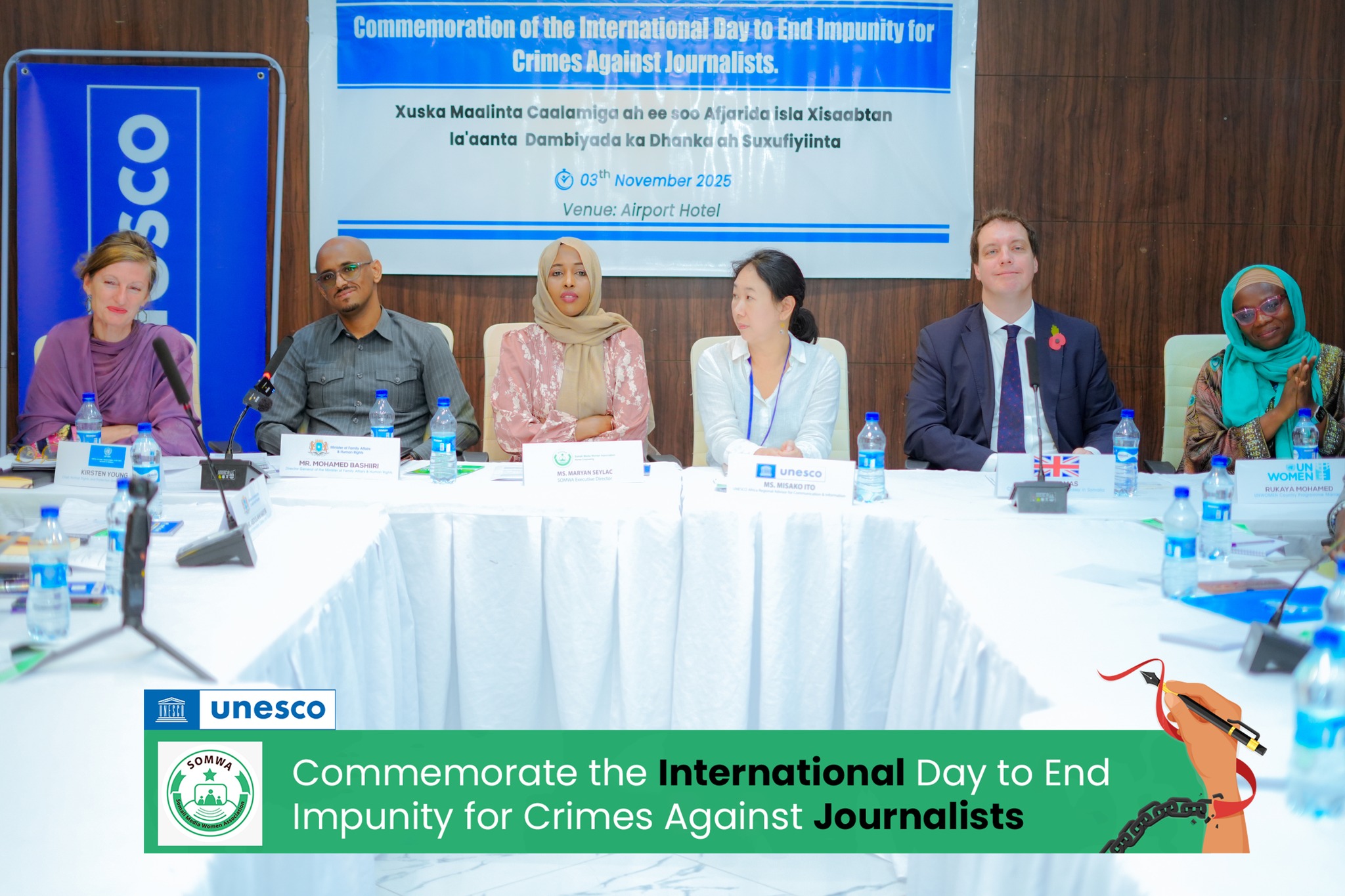
That question echoed through the hall in Mogadishu as journalists, diplomats, and human rights advocates gathered for a one-day workshop on “Digital Safety and Gender Justice: Ending Impunity for Crimes Against Journalists.”
Organized by the Somali Women Media Association (SOMWA) with support from UNESCO, the event marked the International Day to End Impunity for Crimes Against Journalists, calling for stronger protection for women in the media who face escalating digital and physical threats.
Opening the workshop, Maryan Seylac, Executive Director of SOMWA, set the tone with a powerful message. “Every attack on a journalist is an attack on truth, accountability, and the right of people to know,” she said. Seylac highlighted the grim reality facing Somali women journalists, revealing that SOMWA’s recent report recorded a sharp increase in online abuse and harassment targeting female reporters. “These attacks are designed to silence and erase women’s voices from public spaces,” she warned, noting that when women journalists are silenced, democracy itself suffers.
SOMWA’s findings reveal a deeply concerning pattern. Digital violence against women journalists in Somalia is widespread and deeply personal. It includes harassment, threats, and gendered attacks aimed not at their work, but at their identity. Many face abuse simply for being women in public spaces. These attacks spill into private life, causing fear, anxiety, and self-censorship that limits expression and narrows media diversity. Yet Somali women journalists continue to show courage, supporting each other and reporting critical stories.
According to UNESCO, over 73 percent of women journalists worldwide have experienced online threats, often escalating into physical attacks. SOMWA’s data mirrors this global trend, documenting over 60 cases of violations in Somalia in the past year, more than half of which occurred online. The 2025 report by SOMWA further shows that one in three Somali women journalists faces online abuse, often through coordinated defamation campaigns that target their personal integrity rather than professional work.
Her address struck an emotional chord as she urged collaboration between government, civil society, and tech platforms to make digital spaces safer. “The same tools that spread hate can also connect, protect, and empower,” Seylac said. “We must use technology for solidarity and justice.”
Her message was echoed by Mr. Sam Thomas, Deputy Ambassador of the British Embassy in Mogadishu, who commended SOMWA for its leadership. “Justice delayed is justice denied, and impunity must end,” he declared. Thomas reaffirmed the UK’s support for press freedom in Somalia, noting that the British government continues to fund advocacy, training, and partnerships that protect journalists. He paid tribute to fallen Somali journalists, including Amun Abdullahi, who was killed last year for her reporting. “Their names and stories must never be forgotten,” he said.
Thomas also acknowledged the structural challenges, from restrictive laws to social norms that fuel discrimination. “Women journalists face a double burden: threats for their reporting and gender-based violence for being women,” he said. He pledged continued partnership to help Somalia strengthen its legal frameworks, reform the penal code, and uphold media freedoms.
UNESCO’s representative, Misako Ito, provided a sobering global overview. Since 2006, more than 1,800 journalists have been killed worldwide, with 90 percent of cases unresolved. Somalia remains one of the most dangerous countries for journalists. UNESCO has requested updates from Somali authorities on the 57 unresolved killings of journalists. Ito emphasized that digital spaces have become a new battlefield for gender-based violence, often amplified by artificial intelligence and algorithmic targeting. “AI can spread hate, but it can also be used to build safety and accountability,” she said.
The event also heard from OHCHR’s Kirsten Young, who drew a crucial link between attacks on journalists and broader human rights deterioration. “When journalists are silenced, human rights violations become invisible,” she said. She warned that the closure of 75 percent of one-stop centers for gender-based violence survivors in Somalia has further reduced access to justice and information. “If women journalists cannot report freely, issues affecting women disappear from public discourse,” she added.
Her call for accountability was echoed by UN Women’s Representative Rukaya Mohammed, who described digitalization as “a double-edged sword.” While technology can empower, she noted, it has also become a breeding ground for violence. “Freedom of expression is a women’s rights issue,” she said. “Somali women journalists are shaping narratives, holding power to account, and redefining what leadership looks like.”
The UN Women representative urged stronger collaboration among government, tech companies, and civil society to criminalize online abuse, enforce digital safety laws, and boost digital literacy for women and girls. “Let us transform technology from a space of fear into a platform of empowerment,” she said. “No woman journalist should be silenced by threats or impunity.”
Opening the event, Mr Mohamed Bashir, Director General of the Ministry of Women and Human Rights Development, noted that while digital spaces have created opportunities for women, they have also exposed them to harassment and intimidation. He stressed that freedom of expression must not come at the expense of safety—especially for women journalists—and reaffirmed the Ministry’s commitment to ensuring a safe and secure digital space for al
Throughout the workshop, participants emphasized that protecting women journalists is not just about preventing harm but safeguarding democracy. The discussions turned toward practical measures, including Somalia’s ongoing legal reforms.
Legal Perspective – Somalia
Somalia is still rebuilding its legal and political systems, including those that address defamation and gender-based digital violence. Existing laws such as the Penal Code of 1962 and the Media Law of 2016 do not specifically mention online or gender-based offenses, leaving a critical gap. For example, Article 451 of the Penal Code covers defamation but does not extend to online contexts or gendered attacks. The Media Law, meanwhile, focuses on press rights and responsibilities without addressing digital harassment.
The Data Protection Act of 2023 was a positive milestone, prohibiting the harmful or defamatory use of personal data. While it does not directly address gender-based digital violence, Articles 4 and 18 can indirectly protect women journalists if effectively enforced.
To close the gap, legal experts at the workshop recommended:
- Introducing explicit legal provisions on gender-based digital violence.
- Harmonizing laws to reflect digital realities.
- Strengthening the capacity of judicial and law enforcement institutions to handle online violence cases.
- Ensuring the Data Protection Act includes gender-sensitive implementation measures.
Access to Justice
When female journalists experience online threats, access to justice remains limited. Cases rarely reach court due to lack of digital evidence handling, weak technical capacity, and social stigma. Participants urged the establishment of specialized digital crime units within the Ministry of Justice and the Police Force. Judges, prosecutors, and police officers must be trained in handling digital evidence and applying gender-sensitive approaches to ensure victims are not retraumatized.
Collaboration and Responsibility
Organizations such as SOMWA play a critical role in protecting women journalists. They should continue to work closely with the Ministry of Justice, the Office of the Attorney General, and the Police Force to establish coordination mechanisms for responding to digital threats and defamation cases. Collaborative awareness and training programs are essential for ensuring that both government agencies and media associations understand and fulfill their responsibilities to safeguard women journalists.
Future Outlook
Creating a safe and respectful digital environment in Somalia will require collaboration among government institutions, civil society, and tech platforms. A Digital Ethics Code should be developed to promote responsible online behavior and digital literacy. Effective monitoring systems are needed to curb hate speech and defamation while protecting freedom of expression.
The director general of the Ministry of Information, Culture and Tourism, represented by Mr. Abdulahi Hayir, reaffirmed the government’s commitment during the event. He noted that Somalia has prioritized press freedom and the safety of journalists as central to democracy. The Ministry, in collaboration with partners, continues to review media laws and strengthen coordination between the media, police, and judiciary. To address growing online abuse, the Ministry has developed a policy initiative on responsible social media use, soon to be presented to the Council of Ministers for approval.
This government acknowledgment marked a hopeful step. Yet, as participants stressed, laws alone are not enough. Real change requires enforcement, education, and solidarity. Media organizations must adopt policies on digital safety, provide mental health and legal support, and ensure female journalists have safe reporting environments. Social media companies must also be held accountable for abusive content in Somali-language spaces.
Women journalists can take personal precautions, but they should not face digital violence alone. When institutions invest in safety and accountability, they are not just protecting individuals—they are protecting press freedom.
As the event drew to a close, Maryan Seylac reminded everyone, “Women journalists are not victims to be protected. They are leaders to be supported. They are storytellers shaping Somalia’s future.”
Her words captured the spirit of resilience and hope that defined the day. Protecting Somali women journalists is not only a moral duty but a democratic necessity. In her closing remarks, she cited the words of Kenyan journalist Salome Sakwe:
“The silencing of one woman journalist amounts to the silencing of a thousand women’s voices.”
In Mogadishu, those voices are rising again, louder and stronger—determined to tell their stories and claim their space in the digital world.