

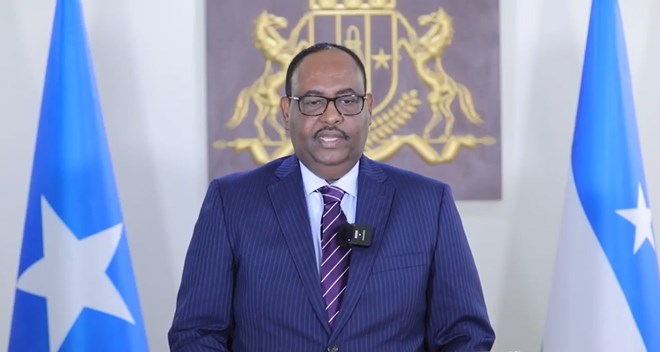
GAROWE, Somalia — Puntland President Said Abdullahi Deni has called on Somali President Hassan Sheikh Mohamud to resign, accusing him of failing to unite the country and organize elections through an inclusive political agreement.
In an interview with Puntland state television (PL TV), Deni criticized the federal government’s proposed national dialogue with opposition groups, describing the planned talks as a waste of time and questioning their prospects of producing meaningful results.
“There is nothing to expect from Hassan. He cannot organize elections, and his meetings are a waste of time. We are calling on the Somali people to engage in genuine consultations. Puntland will not hold back and will work for its own interests and those of the Somali nation,” Deni said.
The Puntland leader also urged Mohamud to step aside, saying the country needed a new political arrangement to address the current crisis.
“I would advise Hassan Sheikh, out of consideration for the people, the country and even himself, to resign,” Deni said.
He called on Somalis, particularly residents of Puntland, to support efforts to safeguard the country, warning that Somalia was facing a critical situation requiring collective action.
“Today, there has never been a time when Somalia needed us more than it does now,” he said, urging Puntland residents not to withhold their support from initiatives aimed at saving the country.
Deni stressed that Puntland remained part of Somalia and said his administration would continue working in the interests of the country despite its political disagreements with the federal government.
His remarks come amid an escalating dispute between Mogadishu and Puntland over constitutional changes, the electoral framework and the future of Somalia’s federal political system.
The federal government has invited opposition groups and other stakeholders to a national consultative conference scheduled for November 14-18 in Mogadishu, seeking agreement on the country’s political and electoral arrangements.
However, Puntland and several opposition figures have challenged the government’s approach, arguing that major political decisions require broader consensus among federal member states and other stakeholders.
The disagreement has deepened uncertainty over the electoral process and the transition to the next federal leadership.