


Mogadishu, June 17, 2025 – Somalia’s top religious leader issued a stern warning on Monday about the country’s fragile political environment, questioning the credibility of future elections as national consultations opened in the capital on Monday.
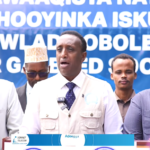
Sheikh Bashir Ahmed Salad, head of the Somali Religious Scholars Council, delivered a blunt speech during the first day of the National Consultative Conference, an initiative launched by President Hassan Sheikh Mohamud to chart a political roadmap for the nation.
“There is no trust,” Sheikh Bashir said. “An election that can be deemed credible is simply not possible under the current conditions.”
He cited the absence of a functioning Constitutional Court as a major impediment to holding fair, one-person-one-vote elections, warning that without an independent judiciary, electoral disputes are bound to deepen political divisions and public distrust.
“How can there be confidence in an election when there is no constitutional court to arbitrate?” he asked.
Sheikh Bashir also criticised what he described as the monopolisation of state power, stating that Somalia belongs to all its citizens. “The country is not private property. ‘Hasha Maandeeq’ does not belong to one person – leadership is a collective responsibility,” he said, referencing a cultural metaphor for Somalia’s shared national wealth.
Calling for an inclusive and transparent approach to resolving electoral disagreements, Sheikh Bashir urged the formation of independent committees to mediate political conflicts. “Every dispute has a solution if faced honestly,” he said.
His remarks, while not publicly acknowledged by Villa Somalia officials, have sparked significant public discussion. Analysts say his speech highlights growing concerns over governance, institutional independence, and the viability of Somalia’s democratic transition.
The National Consultative Conference is expected to continue in the coming days, with leaders hoping to reach consensus on key political and constitutional issues. However, Sheikh Bashir’s intervention suggests that public trust in state institutions remains a critical challenge ahead of any future vote.