

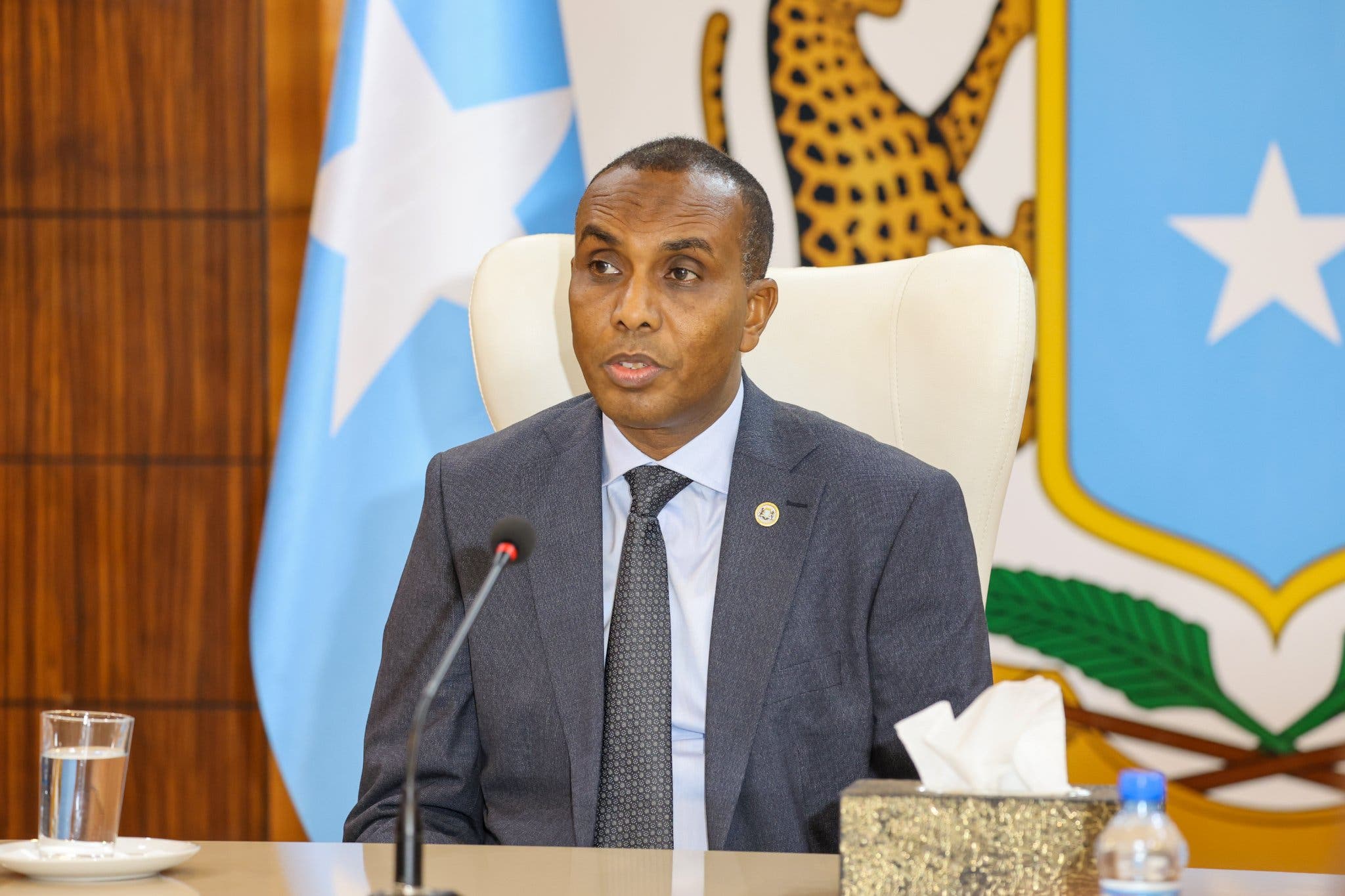
MOGADISHU — In a bold political statement that could redefine Somalia’s fragile democracy, Prime Minister Hamza Abdi Barre announced this week that the country would no longer rely on the traditional clan-based system to elect its leaders — a model that has shaped Somali governance since the collapse of the central government in 1991.
Speaking in the capital, Mr. Hamza described the long-promised shift to universal suffrage as both overdue and irreversible.
“We are moving away from lawmakers appointed by clan elders or regional administrations,” he declared. “We want representatives elected directly by the Somali people.”
The announcement comes at a time when Somalia is grappling with both political and institutional uncertainty. Successive governments have pledged to move toward direct elections, but progress has been slow and marred by political infighting, insecurity, and a lack of infrastructure.
Since the early 2000s, Somalia has operated under a complex power-sharing formula known as the “4.5 system,” which divides parliamentary seats among the country’s four major clans, with a half-share for minority groups.
While credited with preventing civil war and allowing for some degree of governance, critics argue that the model entrenches division, stifles political innovation, and marginalizes citizens without clan influence.
Now, with 53 political parties registered and a shrinking window before the current administration’s term expires, the Prime Minister insists there is still time to organize both parliamentary and local elections based on direct voting. It’s an ambitious claim, given the logistical and security challenges across the country — particularly in areas still contested by the al-Shabaab insurgency.
The Prime Minister also used the occasion to address growing public dissatisfaction with service delivery, ordering immediate reforms at Aden Adde International Airport, the country’s main air hub, after a wave of complaints from travelers. In a nation trying to rebrand itself after decades of conflict, the airport is both a symbol and a test of government capacity.
Still, the real test lies in whether Somalia’s political class — many of whom rose to power through the very clan-based structures now being dismantled — will allow such reforms to materialize.
Changing the electoral system is not simply a procedural matter. It strikes at the heart of how power is distributed in Somalia — and how it has been preserved. For Mr. Hamza, pushing forward with universal suffrage could either cement his legacy or provoke fierce resistance from political actors with vested interests in the status quo.
But with pressure mounting from both citizens and international partners, Somalia may have reached the point of no return.