

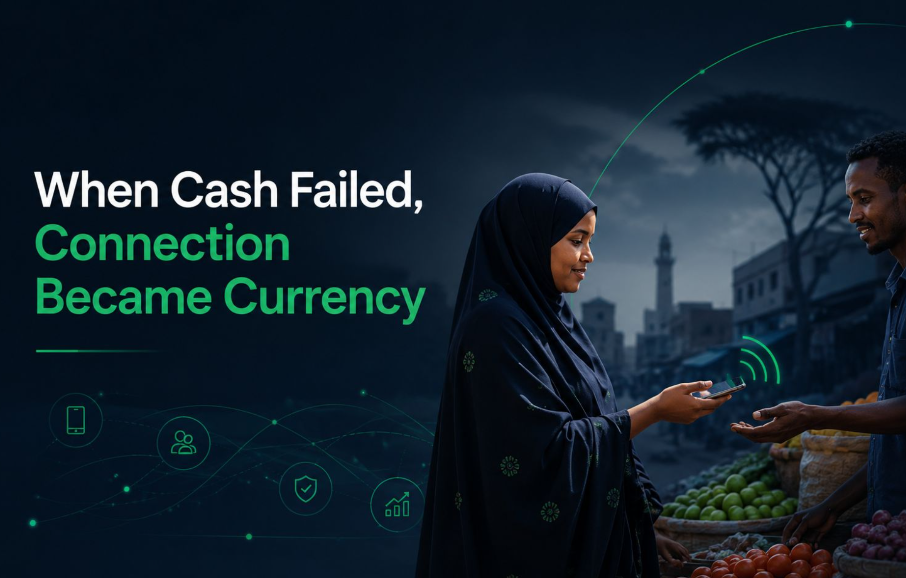
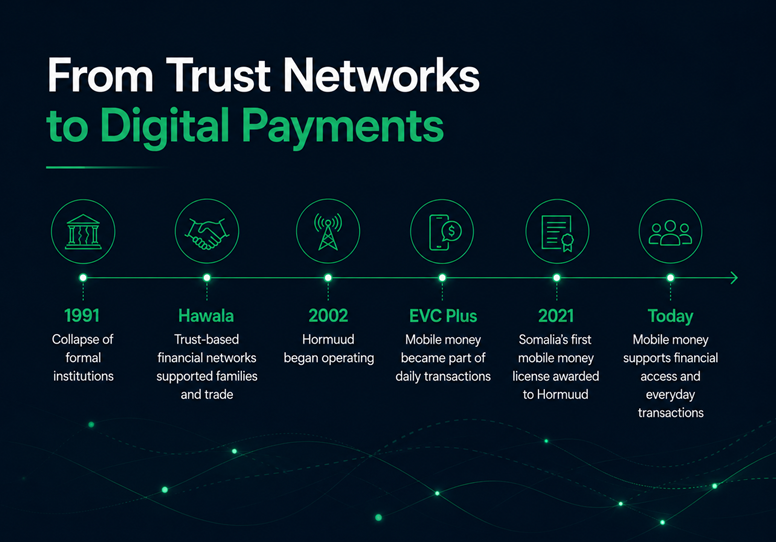
In 1991, Somalia’s central government collapsed. Public institutions weakened, national infrastructure was severely damaged, the formal banking system struggled, and confidence in national financial systems declined. For many Somalis, money became something physical, fragile, difficult to move, and sometimes difficult to trust.
As confidence in the Somali shilling weakened and many transactions shifted toward the U.S. dollar, people needed more reliable ways to exchange value. In markets, shops, transport, family support, and business transactions, daily financial life requires systems that could work even when formal infrastructure is limited.
But Somalia did not stop.
Trust Before Technology
Where formal systems weakened, people created alternatives. Trust became infrastructure. Hawala networks connected families, traders, diaspora communities, and people across borders. These systems were more than financial channels; they were social networks built on reputation, trust, and necessity.
Then, telecommunications began to change the country’s financial possibilities.
When Connectivity Became Financial Access
As mobile connectivity expanded, Somali users moved from basic voice communication toward digital services that supported payments, business communication, information access, and everyday transactions. Hormuud Telecom, which began operating in Somalia in 2002, became part of that transformation through communication services, mobile networks, internet access, and later mobile money. Reuters-republished reporting notes Hormuud’s 2002 operating history and states that Somalia’s first mobile money license was awarded to Hormuud in 2021.
Through EVC Plus, mobile connectivity became more than communication; it became a practical financial tool for everyday transactions.
A major turning point came when mobile money moved from being a telecom feature to becoming part of daily financial life.
EVC Plus did not simply introduce a new payment method. It helped address one of Somalia’s most important financial challenges: how people could exchange value when physical cash was inconvenient, unsafe, scarce, or unreliable.
With a mobile phone, financial activity no longer had to depend on a bank branch, physical cash, or face-to-face exchange. EVC Plus made it possible to send and receive money, pay bills, access bank-linked services, and complete daily transactions through a simple mobile connection. Hormuud’s official EVC Plus service page describes functions such as sending and receiving money, paying bills, and accessing bank accounts.
This changed the role of the phone itself. It was no longer only a communication device; it became a practical tool for moving value, reducing payment delays, and making everyday transactions easier for people and businesses.
Currently, EVC Plus is free to use at the point of transaction, helping reduce cost barriers and expand access to digital payments for everyday users, small businesses, and families.
This is why mobile money in Somalia is not only a technology story. It is also a story of economic adaptation, public trust, and social resilience.
From Convenience to Financial Infrastructure
In some markets, mobile money is seen mainly as a convenience. In Somalia, for many communities, businesses, and families, it has become something closer to financial infrastructure.
Its importance lies in scale and dependency. Mobile money became part of how value moves across markets, households, services, and commercial activity. Instead of being an optional digital tool, it became one of the systems people rely on to keep daily economic life moving while formal financial infrastructure continues to develop.
More recent reporting and market references show that mobile money remains deeply embedded in Somalia’s financial life. The U.S. International Trade Administration’s 2024 Somalia country guide describes mobile money as widespread, with an estimated 73% penetration in the country. [5] Public reporting in 2026 also showed how fragile the remaining cash economy can be, as the rejection of worn Somali shilling notes disrupted traders, transport, and low-income households, while U.S. dollars and phone-based transfers continued to play a central role in everyday exchange.
Recent research has also examined mobile money in Somalia beyond simple payments, describing it as part of the country’s economic adaptation and resilience, especially in a fragile and climate-stressed environment.
In practice, mobile money has become part of Somalia’s daily economic rhythm, present in markets, households, workplaces, and support networks.
The Deeper Impact: Financial Inclusion
Academic research on EVC Plus has examined its role in financial inclusion in Somalia, including access, usage, quality, and welfare dimensions of financial services. This matters because many people who may not have access to formal banking can still participate in digital payments through mobile money.
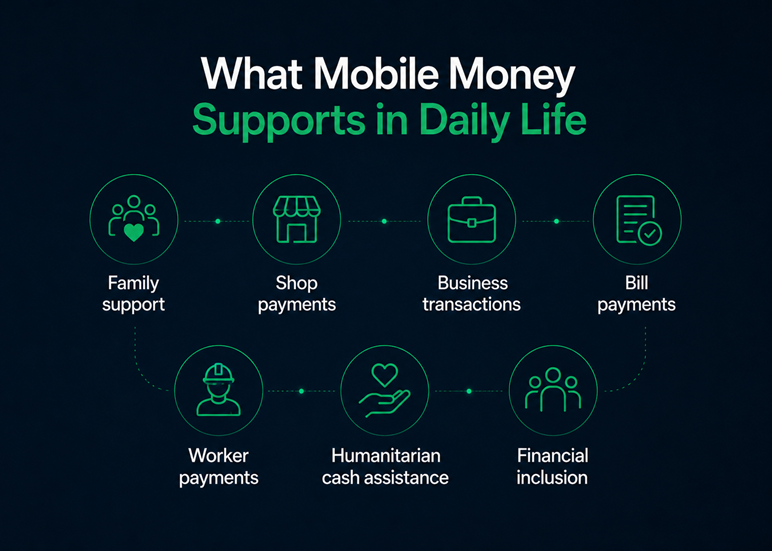
The human impact is visible in the people mobile money brings into the financial system: customers without traditional bank accounts, small traders who need faster payments, families receiving support from relatives, students paying for services, and humanitarian organizations reaching people with greater speed and traceability.
For many users, the value of mobile money is simple: it reduces distance, saves time, lowers dependence on cash, and makes financial participation possible in places where traditional banking may be limited.
Regulation, Trust, and Responsibility
Its importance also became visible at the regulatory and international standards level. The Central Bank of Somalia’s mobile money regulation covers licensing, operation, and supervision of mobile money service providers. Public reporting also stated that Somalia’s central bank awarded Hormuud Telecom the country’s first mobile money license in 2021, a move aimed at formalizing digital payments and integrating them with the wider financial system.
Beyond national regulation, EVC Plus has also been recognized through the GSMA Mobile Money Certification, an international certification programme that assesses mobile money providers against global standards. According to GSMA’s mobile money certification platform, Hormuud’s EVC Plus was assessed across areas including safeguarding of funds, fraud prevention, system security, and data privacy, using eight core principles and nearly 300 criteria. Hormuud also stated that EVC Plus was re-certified by the GSMA Mobile Money Certification programme in 2025, reaffirming its commitment to global best practices in consumer rights, anti-money laundering, and resilient financial service delivery.
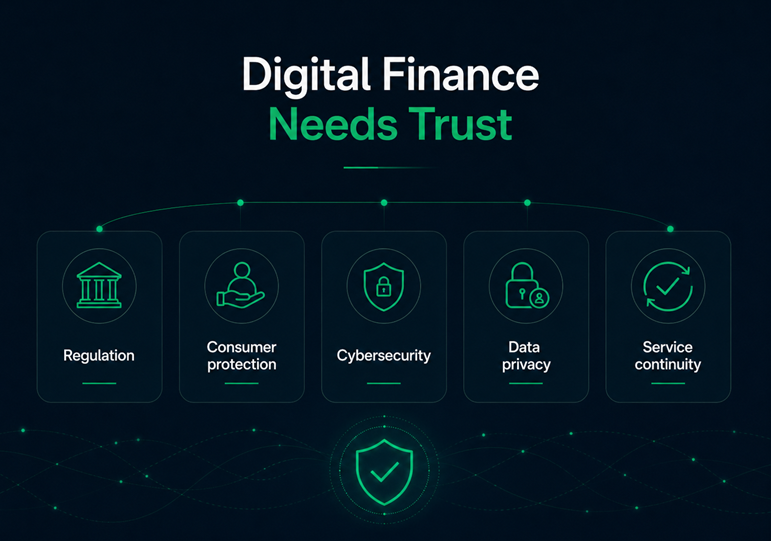
Trust in digital finance is built on more than technology. It requires effective oversight, strong consumer protection, reliable service, secure systems, data privacy, and public confidence that users’ money is protected at every stage.
Like any digital financial system, mobile money requires strong regulation, cybersecurity, agent reliability, consumer protection, data privacy, and service continuity. These safeguards are essential because the more people depend on a digital payment system, the more important its stability, transparency, and public trust become.
What Mobile Money Made Possible
Without mobile money, Somalia’s economy would not stop completely. Somalis are resilient and have always found ways to adapt, but daily life would become slower, riskier, and more expensive. Businesses would depend more heavily on physical cash. Customers would face more barriers. Aid delivery would become more difficult. Small transactions would become less efficient. Financial access would shrink for many people outside traditional banking systems.
EVC Plus represents the kind of innovation that grows from real need.
It was not created only for comfort. It emerged in a market that needed trust, speed, access, and reliability. It helped turn the mobile phone into a wallet, the SIM card into a financial access point, and digital trust into economic movement.
As Somalia continues to expand digital services, mobile money shows how technology becomes most powerful when it solves real problems in people’s daily lives.
That is the power of Somali innovation: when systems fail, people build new ones.
And in Somalia, mobile money not only changed how people pay.
It changed how people live, trade, support one another, and move forward.
References
[1] Hormuud Telecom — “EVC Plus.”
Official Hormuud Telecom service page describing EVC Plus features, including sending and receiving money, paying bills, and accessing bank accounts.
[2] Abdiaziz Ali Mohamed — “Quantifying the Role of Mobile Money Services to Financial Inclusion: Evidence from EVC-PLUS in Somalia.”
Published in Global Social Welfare, Springer. Used for research context on EVC Plus and financial inclusion in Somalia.
[3] Central Bank of Somalia — “Mobile Money Regulation 2020, amended 2021.”
Regulatory document covering licensing, operation, and supervision of mobile money service providers in Somalia.
[4] Reuters-republished report via MarketScreener — “Hormuud Telecom awarded Somalia’s first mobile money licence.”
Used for Hormuud’s 2002 operating history and Somalia’s first mobile money licence being awarded to Hormuud in 2021.
[5] U.S. International Trade Administration — “Somalia: Banking Services and the Financial Services.”
Published January 22, 2024. Used for the statement that mobile money is widespread in Somalia, with estimated penetration of 73%.
[6] GSMA Mobile Money Certification — “Hormuud Telecom awarded GSMA mobile money certification.”
Certification reference describing Hormuud’s GSMA Mobile Money Certification.
[7] Hormuud Telecom — “Hormuud Telecom Receives GSMA Re-Certification for Secure Mobile Money Services.”
Hormuud’s 2025 update on EVC Plus receiving GSMA Mobile Money re-certification.
[8] The Guardian — “‘It’s like we went bankrupt overnight’: poorest Somalis suffer as piles of worthless shillings mount up.”
Published May 11, 2026. Used for context on the fragility of Somalia’s remaining cash economy and continued reliance on dollars and phone-based transfers.
[9] Frontiers — “Investigating the economic dynamics of mobile money in Somalia’s climate-stressed economy.”
Published in 2025. Used for recent research context on mobile money, economic adaptation, and resilience in Somalia.
————————————————————————————————The Author: Abdikafi Hassan Farah