

The African Union is seeking to make democracy a continuous part of public life, with media, civic education and citizen participation central to the effort. A two-day Roundtable in Addis Ababa focused on turning that goal into practical action ahead of the continent’s 2026–2027 electoral cycle.
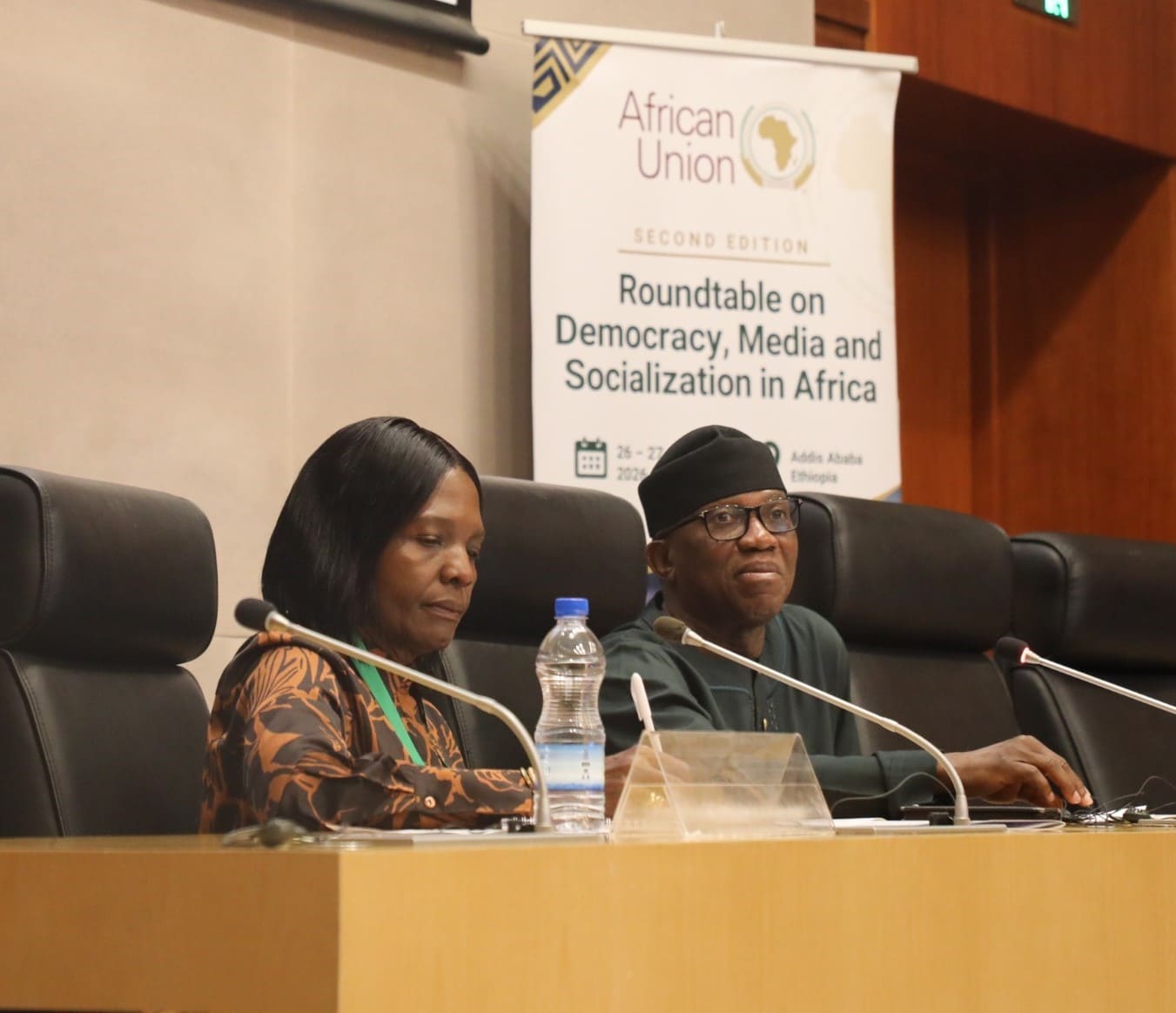
The African Union Commission’s Department of Political Affairs, Peace and Security convened the second Roundtable on Democracy, Media and Socialisation in Africa on 26–27 October under the theme “From Dialogue to Action: Advancing Democratic Resilience through Media, Socialisation and Inclusion in Africa.” It brought together senior AU officials, election management bodies, media organisations, academics, civil society, youth and women’s networks and international partners.
Speaking at the meeting, AU Commissioner for Political Affairs, Peace and Security Ambassador Bankole Adeoye said democratic values should take root across society. “Democracy must be socialised and embedded within our societies, communities, educational systems, media spaces and public institutions.”
Adeoye said African citizens should be at the centre of democratic processes, describing them as “the primary actors and custodians of democratic governance”. He urged participants to develop practical proposals that would improve access to credible information, strengthen civic and voter education and give citizens greater opportunities to take part in public life.
Participants examined how artificial intelligence and digital platforms are changing elections and the information environment. Discussions covered generative AI, platform influence, digital sovereignty and the risks posed by disinformation, misinformation and hate speech. They also considered responses including media literacy, fact-checking, independent journalism and stronger public trust in reliable information.
The Roundtable addressed the conditions needed for journalists to contribute to democratic life, including their safety, working conditions and labour rights. Participants also discussed youth civic engagement, women’s leadership, disability inclusion and community-based approaches to democratic education.
Building on the inaugural Roundtable held in Nairobi in May 2025, participants reviewed progress and gaps since that meeting and identified priorities for the coming year. They highlighted the 2026-2027 electoral cycle as an opportunity to strengthen civic and voter education, pre-election engagement and democratic participation.
The discussions worked towards an Action Roadmap to guide implementation before the 2027 Roundtable. Proposed elements include setting priorities, assigning institutional responsibilities and establishing monitoring and reporting arrangements. Adeoye said the success of the meeting would depend on what followed:
“The ultimate measure of our success will not be the quality of our discussions alone. It will be our ability to translate ideas into actions; commitments into partnerships; and recommendations into sustained interventions that positively influence the democratic experiences of African citizens.”
The Nairobi Roundtable had recommended stronger journalist protection and labour rights, continent-wide media and digital literacy, democracy education and greater support for investigative and community journalism. The Roundtable was supported by International IDEA with funding from the European Union.