

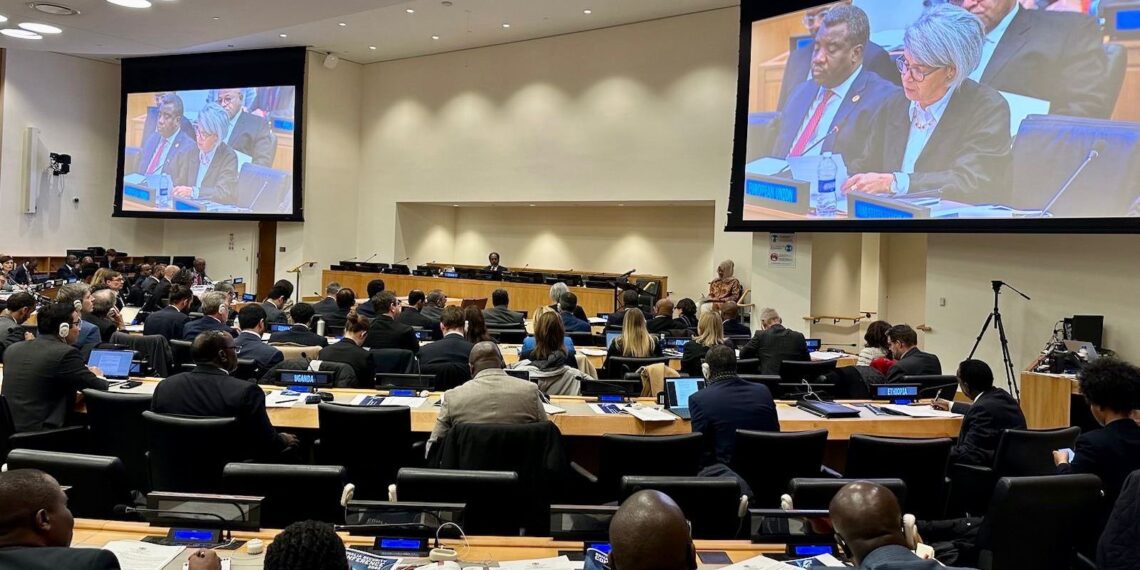
NEW YORK – The Security Council is expected to convene for a private meeting on the African Union (AU) Support and Stabilization Mission in Somalia (AUSSOM) under the agenda item “The situation in Somalia”. Assistant Secretary-General for Africa in the Departments of Political and Peacebuilding Affairs and Peace Operations (DPPA-DPO) Martin Kimani and Special Representative of the Chairperson of the AU Commission (SRCC) for Somalia and Head of AUSSOM El Hadji Ibrahima Diene are expected to brief. The meeting will also include a briefing on the work of the 2713 Al-Shabaab Sanctions Committee. Since the allocation of subsidiary body chairs has yet to be decided, Latvia is expected to brief in its capacity as Council president in November.
The meeting will take place amid growing uncertainty over the future of AUSSOM and the logistical support provided to the mission by the UN Support Office in Somalia (UNSOS). AUSSOM continues to support Somali security forces in operations against Al-Shabaab, but persistent funding shortfalls and uncertainty over international support have raised concerns about the mission’s operational sustainability and the prospects for an orderly security transition.
The Secretary-General’s 28 October report submitted pursuant to resolution 2809 of 23 December 2025, which most recently extended AUSSOM’s authorisation, details UNSOS’ support to AUSSOM and Somali security forces, as well as the financial constraints affecting its operations. UNSOS reduced expenditures by 25 percent against its approved 2025/26 budget of $520.6 million, and the General Assembly’s Fifth Committee approved in June a reduced budget of $481.4 million for 2026/27. Acute constraints facing the trust fund administered by UNSOS affected the delivery of logistical support to Somali forces operating alongside AUSSOM, which requires approximately $2.2 million per month, leading to the temporary suspension of fuel and ration deliveries between May and July. Following a £1 million (approximately $1.4 million) contribution from the UK in August, deliveries resumed and UNSOS expects to sustain the current level of support through December. The Secretary-General warned, however, that persistent funding gaps threaten the continuity and predictability of this assistance.
Between 29 and 31 July, AUSSOM troop-contributing countries (TCCs) held an extraordinary summit in Kampala, Uganda, to discuss the challenges facing the mission. In its communiqué, the summit stressed the need for an “orderly, coordinated and phased exit of AUSSOM” and called for sustained support for 18 to 24 months to enable the implementation of agreed milestones, strengthen Somali security institutions, and facilitate the transfer of security responsibilities. The summit also mandated the foreign ministers of AUSSOM TCCs to seek predictable and sustainable financing.
The US had initially opposed providing support for this period of time. In a 10 September letter to the AU Commission, the US Mission to the AU announced that the US would discontinue its support for UNSOS beyond the current AUSSOM authorisation period, which expires on 31 December. The US opposed the TCCs’ request for support over 18 to 24 months and instead indicated its willingness to allow UNSOS a 12-month drawdown to liquidate its operations and give AUSSOM time to prepare for the withdrawal of UN support. The US is a key contributor to UNSOS’ budget, making such a decision particularly consequential for the mission’s ability to sustain logistical support to AUSSOM. The Secretary-General has warned that interruptions to the mission’s logistical assistance at its current level could have wider operational consequences for AUSSOM.
At the time of writing, the US may have shifted its position on the future of UNSOS and AUSSOM. Yesterday (15 November), Washington reportedly decided to support a one-year renewal of the mandates of both missions. This would mark a significant change from the previously stated position, which envisaged a 12-month drawdown of UNSOS following the expiration of the current AUSSOM authorisation on 31 December. The US has nevertheless stressed that its renewed support should not be understood as an open-ended commitment, calling on Somalia and the AU to develop more sustainable long-term security arrangements. The extent and significance of this reported shift, including its implications for the upcoming negotiations on the mandate renewals in December, are likely to be a key issue at tomorrow’s meeting.
Tomorrow’s meeting also follows the closure of the UN Transitional Assistance Mission in Somalia (UNTMIS) on 31 October, concluding its two-year transition mandated under resolution 2753 of 30 October 2024. Its functions were transferred to Somali institutions and the UN Country Team (UNCT). The Secretary-General’s report described the process as broadly successful but cautioned that declining resources, reduced UNCT capacity, and political disputes could undermine its sustainability. Tomorrow, Kimani is likely to emphasise that this does not signal the UN’s departure from Somalia but rather an evolution in its presence and support. Members may stress the importance of preserving the gains made during UNTMIS’ mandate and maintaining an appropriate UN political presence in line with Somalia’s priorities.
Meanwhile, Somalia’s political and constitutional crisis has deepened. On 5 November, the Supreme Court ruled that the mandates of President Hassan Sheikh Mohamud and the federal parliament had expired in April and May, respectively. In doing so, it rejected the president’s claim that the parliament’s decision in March to extend presidential and parliamentary terms from four to five years provides for a one-year extension of the terms of current officeholders. The Court called on political stakeholders to agree on an electoral framework within 30 days and directed that elections be held within 90 days. It also ruled that the president’s dismissal of Chief Justice Baashe Yusuf Ahmed in a presidential decree dated 4 November was invalid. The federal government has rejected the Court’s ruling, maintaining that it has no legal effect. These developments have further intensified tensions between the federal government and opposition groups, as well as between Mogadishu and federal member states. (For background, see the brief on Somalia in our November 2026 Monthly Forecast.)
Efforts to convene a national dialogue have also encountered difficulties. President Mohamud had invited opposition groups and civil society representatives to a national consultative forum in Mogadishu from 14 to 18 November to discuss the electoral process and constitutional issues. The forum did not open as scheduled on 14 November, however. The Somali Future Council, an opposition coalition, declined to participate in talks and called for international mediation. The government said on 14 November that contacts with invited parties were continuing. The dispute comes as the National Independent Electoral and Boundaries Commission’s announced timetable for parliamentary elections on 15 April 2027 and presidential elections on 15 May 2027 remains contested by opposition groups.
Diene is expected to brief on AUSSOM’s mandate implementation and support for Somali-led operations against Al-Shabaab, including the importance of maintaining deployments while Somali security forces build capacity. The Secretary-General’s report said that joint operations contributed to significant improvements in Mogadishu, but Al-Shabaab remains the principal security threat across south and central Somalia. The group launched coordinated attacks against three AUSSOM bases in the Lower Shabelle region on 5 July. More recently, a suspected Al-Shabaab attack in Kenya’s Mandera County on 10 November killed eight people, underscoring the group’s continued cross-border threat. Council members may express concern that political divisions and tensions among federal and regional authorities could undermine counter-terrorism efforts.
In light of recent reports suggesting a potential policy change in Washington towards supporting and financing UNSOS for a further year in 2027, the US might provide further information on its position at the meeting. Members may nevertheless stress that continued support should be accompanied by planning for a gradual and orderly drawdown of UNSOS, as well as for AUSSOM’s longer-term transition, alongside efforts to strengthen Somali ownership of security responsibilities.
The political situation is also likely to feature in the discussion. Some members may encourage Somali political stakeholders to engage in dialogue and reach agreement on outstanding issues, particularly the electoral roadmap and constitutional reforms.
Coordination among the UN, AU, and AUSSOM TCCs is likely to be another important consideration. Members might emphasise the importance of aligning these discussions and consulting closely with TCCs to ensure that decisions on UNSOS support and AUSSOM’s mandate are informed by operational requirements.