

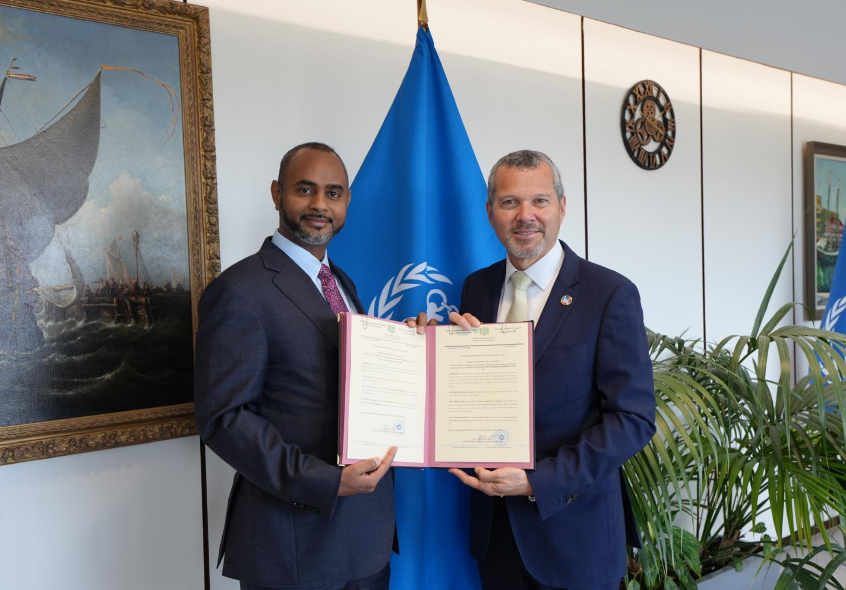
Mogadishu, Somalia – The Ministry of Ports and Marine Transport today announced the decision of the Federal Republic of Somalia to accede to Fifteen international maritime conventions and legal instruments, marking the largest and most significant modernization of the country’s maritime legal framework since independence.
Despite possessing the longest coastline on the African mainland and occupying a strategic position along one of the world’s most important international shipping routes, Somalia has acceded to only three international maritime conventions since gaining independence in 1960.
This landmark step reflects the Government’s conviction that Somalia, with its unique maritime endowments and exceptional strategic location, should no longer remain on the margins of the international maritime legal order. Limited participation in the core international maritime conventions has constrained the country’s full integration into the global maritime transport system, its ability to attract international investment, and its efforts to enhance maritime safety. Today, the Government is taking a historic step to rectify this situation.
The International Maritime Conventions and Legal Instruments to Which Somalia Has Acceded
I. Maritime Safety and Navigation
1. International Convention on Maritime Search and Rescue (SAR), 1979.
2. International Convention on Standards of Training, Certification and Watchkeeping for Seafarers (STCW), 1978.
3. Convention on the International Regulations for Preventing Collisions at Sea (COLREG), 1972.
4. Convention on Facilitation of International Maritime Traffic (FAL), 1965.
5. International Convention on Tonnage Measurement of Ships, 1969.
6. Protocol of 1978 relating to the International Convention for the Safety of Life at Sea (SOLAS), 1974.
7. Protocol of 1988 relating to the International Convention for the Safety of Life at Sea (SOLAS), 1974.
II. Marine Environmental Protection and Oil Pollution Compensation
8. International Convention on Oil Pollution Preparedness, Response and Co-operation (OPRC), 1990.
9. Protocol of 1992 to Amend the International Convention on Civil Liability for Oil Pollution Damage, 1969 (CLC 1992).
10. Protocol of 1992 to amend the International Convention on the Establishment of an International Fund for Compensation for Oil Pollution Damage, 1971 (FUND PROT 1992)
11. Protocol of 1997 to amend the International Convention for the Prevention of Pollution from Ships, 1973, as modified by the Protocol of 1978 relating thereto, (MARPOL PROT 1997)
III. Maritime Security and Liability
12. Convention for the Suppression of Unlawful Acts against the Safety of Maritime Navigation (SUA)
13. Nairobi International Convention on the Removal of Wrecks, 2007 (NAIROBI WRC 2007).
14. Protocol of 2005 to the Convention for the Suppression of Unlawful Acts against the Safety of Maritime Navigation (SUA 2005)
15. Instrument of Accession to the Protocol on the Privileges and Immunities of the International Mobile Satellite Organization and the amending agreement to the Protocol n the Privileges and Immunities of the International Mobile Satellite Organization.
Accession to these international conventions and legal instruments constitutes one of the principal priorities of the Ministry of Ports and Marine Transport and is fully aligned with the Federal Government’s DanQaran agenda and the National Transformation Plan (NTP).
This initiative will bring about a fundamental transformation in Somalia’s management of its territorial waters, strengthen cooperation with international partners in the maritime transport sector, enhance the country’s capacity to combat marine pollution, ensure that vessels operating in Somali waters comply with international safety standards, safeguard the rights of seafarers, and reinforce Somalia’s entitlement to compensation in the event of oil pollution or other maritime incidents.
This legal modernization coincides with major investments in maritime infrastructure, including the transition of the Port of Mogadishu to 24-hour operations. According to the World Bank’s Container Port Performance Index (CPPI), the Ports of Mogadishu and Berbera are rated among the most efficient ports in East Africa.
The Government is also moving forward with plans to develop a modern international seaport near Mogadishu, incorporating a Special Economic Zone (SEZ), with construction scheduled to commence during 2026.
The Ministry of Ports and Marine Transport calls upon all stakeholders in Somalia’s maritime sector, international partners, and the global maritime community to support this historic transformation, which will reinforce Somalia’s position as a responsible and active maritime nation, reaffirm its commitment to international maritime law, and contribute to sustainable economic development as well as the safety and security of international navigation.