

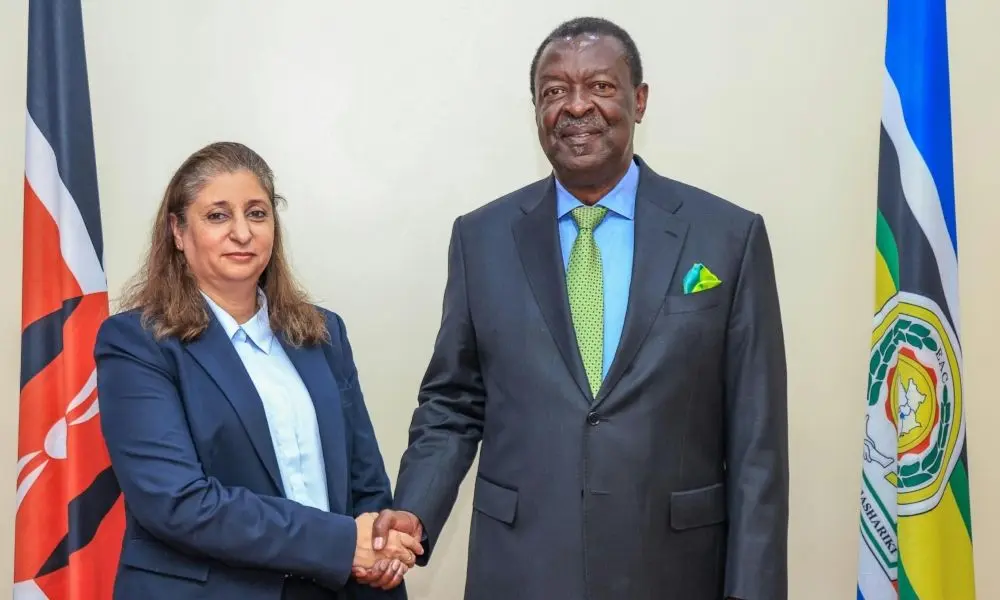
NAIROBI, Kenya – Prime Cabinet Secretary and Foreign Affairs Cabinet Secretary Musalia Mudavadi has reaffirmed Kenya’s commitment to supporting peace and security in Somalia.
The CS warned that stability in the neighbouring country remains critical to Kenya’s security and economic prospects.
In a statement shared on X, Mudavadi said he had met Qurat-ul-Ain Sadozai, Acting Assistant Secretary-General and Head of the United Nations Support Office in Somalia (UNSOS), to review ongoing peace and security efforts and recognise the UN office’s logistical support to African Union-led operations.
He said Kenya would continue to work with Somalia, the African Union (AU), the United Nations and other international partners to strengthen security, consolidate peacebuilding gains and promote lasting regional stability.
“For Kenyans, a peaceful neighbourhood means safer communities, stronger cross-border trade, greater investment and more opportunities for our young people,” Mudavadi said.
The remarks show Kenya’s strategic interest in Somalia’s stability, particularly as regional governments and international partners seek to sustain security operations against the militant group al-Shabaab and strengthen Somali security institutions.
UNSOS provides logistical support to the African Union Support and Stabilization Mission in Somalia (AUSSOM), including food, water, fuel, medical services, transportation, communications and equipment maintenance. The support enables African Union personnel to operate across Somalia alongside national security forces.
According to the UN office, its mandate covers logistical support for up to 11,826 uniformed AUSSOM personnel, including 680 police officers, as well as support for up to 20,900 Somali security personnel involved in joint or coordinated operations with the mission.
The UN Security Council, through Resolution 2809 adopted in December 2025, extended AUSSOM’s authorisation until December 31, 2026, while maintaining UN logistical support arrangements. The resolution also called for additional funding to help sustain the mission’s operations and consolidate security gains in Somalia.
However, financing remains a significant challenge. In July 2026, Reuters reported that the United States planned to oppose the continuation of UN logistical support for AUSSOM beyond 2026, raising concerns about the mission’s ability to sustain its operations without an alternative funding arrangement.
Any disruption to logistical support could affect the deployment, mobility and operational capacity of African Union forces and Somali security personnel, increasing pressure on regional governments to secure sustainable financing for the mission.
Insecurity in Somalia has implications for border security, regional commerce and investor confidence, making cooperation with Mogadishu and international security partners an important part of Nairobi’s regional policy.
Kenya has also contributed troops to African Union operations in Somalia, placing it among the countries directly invested in the mission’s effectiveness and the gradual transfer of security responsibilities to Somali forces.
Mudavadi’s latest engagement signals Nairobi’s continued emphasis on a coordinated regional and international approach to Somalia’s security challenges. However, sustaining progress will depend not only on military operations but also on predictable financing, stronger Somali institutions and continued cooperation among the country’s political and security stakeholders.